Word Six
Bag of BonesWord Six, the word-processing program Michael Noonan once used to write, becomes a precise and increasingly charged object in his struggle with a writing block. Its blank screen is not simply an unwelcome reminder of unfinished work: opening the program brings on physical distress, and the icon itself comes to stand for a lost capacity he still longs to recover.## A program he can approach only on other terms Michael can still use his computer for limited tasks, but the boundary is sharply drawn around Word Six. He tells Harold Oblowski that his sales have settled into a plateau, concealing the deeper crisis: almost every time he opens the program and sees the blank screen and flashing cursor, he suffers heart palpitations. The symptoms make the software a trigger with a bodily consequence, not merely a tool he finds unproductive.
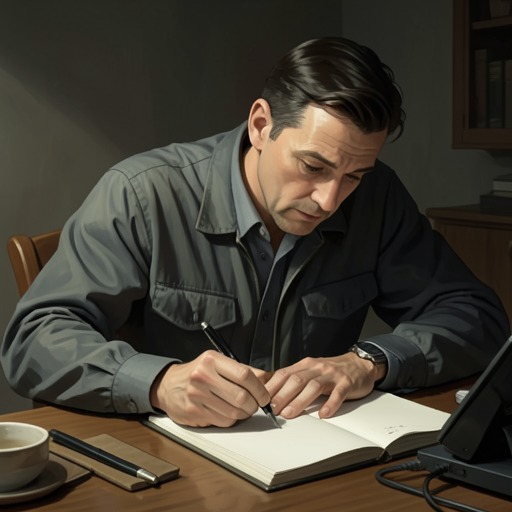
That boundary shapes even the practical business of sending out a manuscript. Michael can compose two accompanying letters on the computer so long as he uses Note Pad; Word Six is what makes the storms begin. He avoids attempting a novel in Note Pad because he fears losing that remaining option too, along with his ability to play Scrabble and solve crosswords. Longhand has also failed, and he knows the problem is not simply screen shyness. The contrast between the functions he can still use and the one he cannot gives the program a specific place in his blocked life: it marks a limit that ordinary workarounds do not overcome.## The failed return On New Year’s Day 1998, the limit briefly seems to have lifted. After the holiday, Michael wakes to a clear, cold morning and suddenly feels that he can write again, as if something has changed and a weight has rolled away. He enters the study and opens the computer. At first his heart beats normally, his hands are warm, and he does not sweat. Then he clicks Word Six. The appearance of its pen-and-parchment logo is enough to bring back the crisis: he cannot breathe, claws at his sweatshirt, and tips backward when his chair catches on a small rug Jo had found during the last year of her life. He blacks out after striking his head. The near-fatal intensity of the episode makes the attempted return more than a setback; the familiar program turns the hope of beginning again into an immediate bodily danger.
In March, the icon confronts him again on the Powerbook. He has opened the main menu to reach crossword puzzles, but the cursor passes the intervening choices and highlights Word Six. What follows is not the frustration or thwarted anger he has experienced since finishing All the Way from the Top. Instead, he feels sadness and longing. The icon calls up the same desire for the irrecoverable that he associates with the photographs of Jo in his wallet: he thinks he would give his soul to write a story again. The comparison does not erase the difference between the losses; it shows how closely writing has become bound to grief and to the wish for what cannot be restored.## Deletion and unresolved meaning A voice urges Michael to try opening the program, suggesting that perhaps things have changed. He refuses the invitation because he already knows they have not. Rather than click the icon, he drags Word Six to the trash barrel in the lower-right corner of the screen and drops it there. Calling it an old pal as he says goodbye gives the gesture the intimacy of a parting, even as the deletion offers no evidence that his writing block has ended.
Word Six thus shifts from working instrument to test, reminder, and relinquished companion. Its logo first appears to confirm Michael’s hope of recovery, but instead exposes how little has changed; later, its presence among the crossword options makes longing momentarily audible, only for him to choose deletion. The object’s final significance lies in that unresolved contrast: he wants the ability to write, recognizes the program as the site where his body refuses the attempt, and removes the icon without recovering what it once enabled.